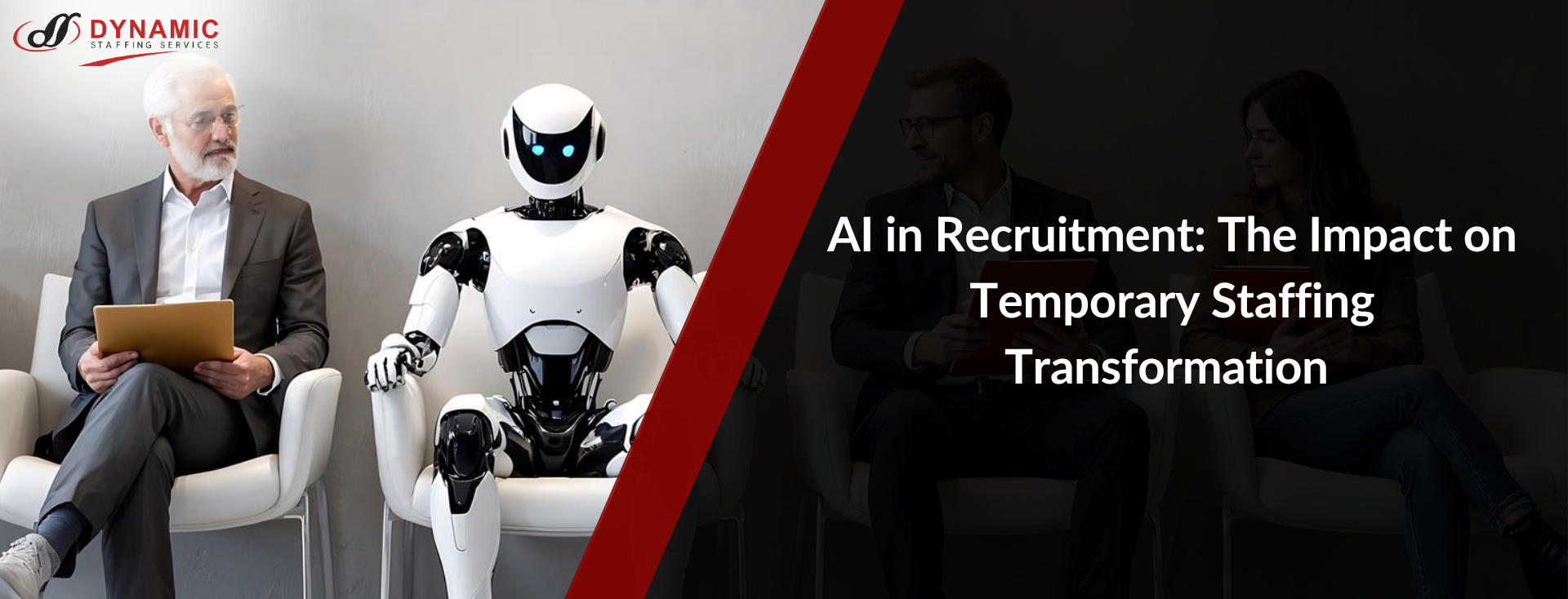
Artificial intelligence is transforming how organisations attract, assess, and retain talent. Its impact on temporary recruitment and staffing is particularly noteworthy. As businesses face fluctuating demand, tighter labour markets, and rising compliance requirements, traditional recruitment methods are struggling to deliver speed and consistency at scale.
AI in recruitment now plays a critical role in helping temporary top recruitment agencies and staffing providers respond faster, make better-informed decisions, and improve workforce outcomes without sacrificing governance or human oversight. For HR leaders, talent acquisition teams, workforce planners, and operations managers, this matters now more than ever. Deploying qualified temporary talent quickly and responsibly has become a competitive necessity, not a desirable feature.
At Dynamic Staffing Services, AI is viewed as a strategic enabler. It supports recruiters, strengthens compliance, and enhances workforce agility in real-world hiring environments.
What is AI in Recruitment?
AI in recruitment means using technologies like machine learning, data analytics, and automation as a way to enhance recruitment processes. In the temporary staffing sector, these technologies are extremely helpful in dealing with a large volume of hiring, short-term assignments, and the complicated management of a workforce spread across roles and locations.
AI is not there to take over recruiters’ jobs but to enhance their work by dealing with large datasets, recognising patterns, and freeing them from repetitive tasks through automation. With a careful AI implementation, one gets improvement in accuracy, consistency, and speed, but still, the crucial human decisions, as well as managing the relationships, are what people do.
Recognised regulators and governments have emphasised the importance of responsible AI use in hiring. For example, UK government guidance on Responsible AI in Recruitment highlights the need for transparency, human oversight, and active bias mitigation when using automated tools. It also warns of risks such as algorithmic bias and digital exclusion, where certain groups may be disadvantaged if systems are not carefully designed, monitored, and supplemented with human judgment.
Key Ways AI Is Transforming Temporary Staffing
Talent Sourcing and Screening
AI-driven document mining is now playing a major role in modern recruitment workflows. It helps staffing firms scan CVs, certifications, employment records, and application documents at scale, making candidate sourcing significantly faster.
Temporary recruitment requires fast access to broad talent pools. AI-supported sourcing helps identify suitable candidates by analysing databases, past placements, and application activity more efficiently than manual searches.
Automated screening filters candidates using objective criteria such as experience, certifications, availability, and role requirements. This reduces processing time and administrative effort, which is critical in time-sensitive temporary hiring. Deeper analysis also helps uncover transferable skills that may not be obvious from job titles, improving shortlist quality and access to qualified talent.
In practice, this may involve AI pre-screening thousands of applications for a short-term warehouse, logistics, or healthcare assignment based on availability, certifications, and role requirements, while experienced recruiters conduct final reviews, interviews, and suitability checks. This human-in-the-loop model enables speed at scale without removing accountability or contextual judgment.
Workforce Planning and Demand Forecasting
Predictive workforce planning helps organisations anticipate staffing needs more accurately. By reviewing historical hiring data, seasonal patterns, and operational trends, workforce requirements can be forecast with greater confidence.
By facilitating proactive staffing decisions as opposed to reactive ones, this information lowers the risk of last-minute hiring and improves company continuity in sectors like manufacturing, logistics, healthcare, and hospitality.
Speed, Scalability, and Cost Efficiency
Automation speeds up recruitment tasks like shortlisting, scheduling interviews, onboarding paperwork, and assignment tracking. This reduces the time spent hiring while maintaining clear oversight and process control. AI also makes it easier to expand the hiring process. Whether it is building small teams or large multi-location workforces, recruitment can be handled in such a way that costs are reduced and mobilisation is faster.
Candidate Matching and Skills-Based Hiring
Skills-based matching makes placements more accurate by taking into consideration the capabilities, availability, and performance of previous assignments of the candidates, rather than just the keywords in the CVs. This results in better role fit and less turnover in temporary staffing. A recruiter review, backed by a matching system, balances speed with quality, ensuring the candidates are suitable both technically and operationally.
Benefits of AI for Employers and Staffing Providers
- Reduced Time-to-Hire: AI-powered recruitment streamlines candidate identification and automates repetitive recruitment tasks, thereby significantly shortening the hiring cycle. Businesses that are able to make faster placements can maintain the level of their productivity, meet their operational deadlines, and respond to changes in demand effectively.
- Improved Workforce Quality: The combination of AI and human judgment through the use of insights that are supported by AI empowers recruiters to select those candidates that best suit the role. If the skills of the candidate really meet the requirements of the role, this can have a positive effect not only on an increased level of performance but also on the satisfaction of both the client and the worker.
- Stronger Compliance and Operational Control: Temporary staffing is surrounded by complex compliance requirements like right-to-work checks, role-specific certifications, and adherence to local labour rules and regulations. AI tools support compliance by maintaining records, automating workflows, and identifying potential risks ahead of time.
For global staffing partners like Dynamic Staffing Services, this compliance-first approach is essential to delivering consistent, trustworthy workforce solutions across regions.
Human + AI: Why Technology Doesn’t Replace Recruiters
Although AI can bring efficiencies and extend analytical capabilities, recruitment is, in essence, a human activity. A technology, for instance, cannot substitute contextual judgment, relationship building, or hearing from the local market. Seasoned recruiters represent:
- Insight into client culture and operational realities
- Candidate engagement and trust, building
- Nuanced decision-making in complex or ambiguous cases
- Regulatory awareness and accountability
At Dynamic Staffing Services, we use AI to enhance recruiter effectiveness, not to automate employment decisions. Our approach reflects decades of staffing expertise and is supported by internal policies that require human validation, documented decision-making, and compliance sign-off for all placements. It is through such a human-led approach that decision-making in hiring can be timely, equitable, and responsible.
Ethical, Compliance, and Data Considerations
The extensive employment of AI in recruiting also leads to a number of very serious ethical and governance questions. Without sufficient checks and balances, AI programs unintentionally exhibit bias or even complicate the decision-making procedures. Responsible use of AI entails:
- Bias mitigation: Proper and consistent assessment of data inputs and outcomes
- Transparency: Better understanding of where and how AI assists in decision-making
- Data protection: Appropriate and secure storage of sensitive candidate data
- Regulatory alignment: Observance of the labour and privacy laws of various jurisdictions
At Dynamic Staffing Services, AI-enabled recruitment operates within a defined governance framework supported by internal compliance policies, recruiter training, and periodic reviews of technology-led decisions. Our recruiters remain accountable for all final hiring outcomes, and AI outputs are treated strictly as decision-support tools rather than automated decisions.
How Dynamic Staffing Services Leverages AI Responsibly
Dynamic Staffing Services has a rich heritage of international recruitment, dating back to 1977. In fact, the company is carrying forward a heritage that new AI-powered workforce solutions are currently enabling. The founding chairman, Maj. S. P. Khosla, a former Indian Army officer, was instrumental in crafting the overseas employment framework of India in the 1980s, and he led the evolution of the organisation into a worldwide staffing partner. Currently, DSS is globally connected through a network of more than 25 offices and more than 250 recruitment professionals.
After being actively involved in various industrial sectors like construction, manufacturing, hospitality, engineering, and many others for decades, we merge our in-depth sector knowledge with a comprehensive understanding of the regulatory framework, cross-compliance, and practical realities. This foundation helps us to establish a reputation as a dependable, compliant, focused global workforce partner.
At Dynamic Staffing Services, we believe that technology can enhance rather than replace human judgment. Our recruitment model is both tech-enabled and people-driven, which means we combine advanced analytical tools with the knowledge and empathy of experienced staffing professionals. This cohesive method allows us to:
- Improve talent visibility and workforce planning
- Manage large‑scale recruitment with agility and precision
- Maintain compliance across diverse international markets
- Equip recruiters with timely, data‑driven insights
Smart technology and seasoned skills are combined to provide recruitment solutions that produce long-term value for our clients while adapting to real-world business difficulties.
Client Experience: AI in Action at Dynamic Staffing Services
Using the example of a Dynamic Staffing Service, we see that AI is not only a separate technology but a component of a hybrid model, where humans lead the recruiting activities.
European Logistics & Distribution Client
A local logistics firm had to deal with frequent labour shortages at the most demanding times; thus, delivery times were negatively affected. By utilising AI, enabled workforce forecasting combined with recruiter validation, DSS enhanced talent availability and shortened the hiring time while staying compliant in several locations. The client was able to staff more predictably and thus, better handle the operational continuity of seasonal spikes.
Manufacturing Expansion Project, Middle East
The manufacturing client expanding its new production line was unable to find technically skilled temporary operators for a very short time. DSS used AI to support skills identification with the combination of compliance and first recruitment, facilitating quicker recognition of the worker’s skills and their readiness for the role. The plant achieved the full production efficiency level as was planned, and the early-stage attrition rate remained well below the industry benchmarks. Contact us to know more about how we support large-scale workforce mobilisation.
These results demonstrate that AI combined with the experience of recruiters brings real value in temporary staffing situations.
Frequently Answered Questions
- Is AI suitable for high-volume temporary hiring across multiple locations?
Yes. AI is highly effective for managing large-scale, multi-location hiring. It enables staffing providers to process extensive candidate pools efficiently, maintain consistent screening standards, and scale recruitment operations without compromising quality or compliance.
- Does AI replace recruiters in temporary staffing?
No, AI support can increase the efficiency of recruiters by taking care of tasks related to volume, data analysis, and administration. Contextual judgement, cultural fit assessment, negotiation, and compliance interpretation remain human responsibilities. The most effective recruitment models use AI to enhance, not replace, recruiter expertise.
- How does AI support compliance and candidate data protection in global staffing?
AI helps track documentation such as right-to-work verification and certifications, monitors regulatory requirements, and standardises compliance processes across regions. However, effective compliance depends on strong governance frameworks and robust data privacy safeguards.
- Does AI in recruitment reduce hiring bias?
By emphasising objective factors like availability, experience, and talents, AI can help reduce some prejudices. However, bias reduction requires responsible system design, regular audits, and ongoing human oversight to ensure fair and inclusive outcomes.
- What should employers look for in an AI-enabled staffing partner?
Employers should choose AI-enabled staffing partners who not only have access to AI technology but also have in-house, highly qualified recruiters and strong compliance governance capabilities, and who follow ethical hiring practices. Human expertise or accountability should never be sacrificed or replaced by AI. Instead, AI should be used as a decision-making tool.
Read More:- Permanent vs. Temporary Workers in Engineering & Construction: What’s Right for You?