






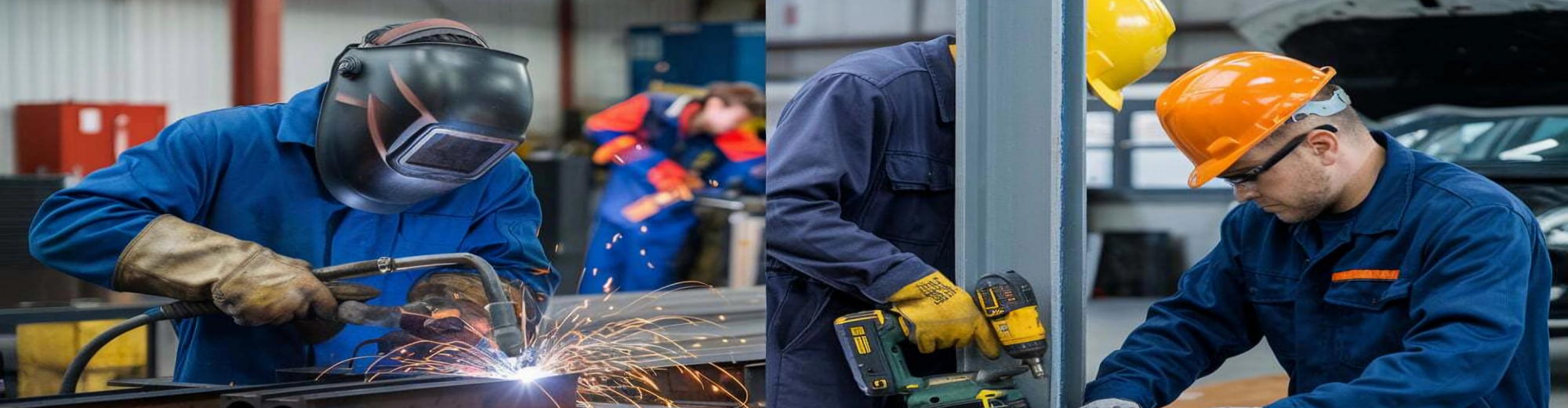
Manufacturers looking to hire welders for Czech Republic projects need to verify more than years of experience. A welder may be competent in one process, material, joint type and position but unsuitable for another.
The recruitment brief must therefore match the production requirement precisely. At Dynamic Staffing Services, we help manufacturers, fabricators and EPC contractors source welders against defined welding procedures, qualification ranges and project schedules. Our process focuses on evidence: valid documents, controlled practical tests and results that employers can review before selection.
Industry Challenges in Czech Republic
Czech manufacturing remains strongly connected to automotive production, machinery, metal fabrication and export supply chains.
The Czech Automotive Industry Association reported that 2025 was the country’s second-strongest year for passenger-car production, with record bus production and record sales among its member companies. It also reported that more than 92.5% of passenger cars produced were exported. This level of export activity places continued pressure on manufacturers and suppliers to maintain output, dimensional accuracy and delivery performance.
Labour availability adds another constraint. EURES lists building and related trades workers, excluding electricians, among the occupational groups with the highest occurrence of shortages in Czechia in 2024. Its wider European shortage review also identifies welders among the occupations most frequently reported as difficult to fill.
For employers, the problem is not simply finding someone who can create a weld bead. The harder task is finding welders whose competence matches the approved production method. Common hiring difficulties include:
- Certificates that do not cover the required process or material
- Experience limited to workshop fabrication when site work is required
- Weak control of distortion, heat input or interpass cleaning
- Inability to read welding symbols and fabrication drawings
- Good visual appearance but poor internal weld quality
- Candidates tested on easier joints than the actual production work
- Qualification documents that have expired or cannot be verified
A mismatch may lead to repair work, additional inspection, material waste and delayed release of fabricated items.
Why Businesses Need This Workforce
Certified welders support more than daily production. Their work affects structural integrity, traceability, inspection results and client acceptance.
Czech manufacturers and EPC contractors may require welders for automotive components, machinery, steel structures, pipe assemblies, transport equipment, industrial maintenance and specialised fabrication. Each application can require a different combination of:
- Welding process
- Parent material
- Filler material
- Product form
- Material thickness
- Pipe diameter
- Joint type
- Welding position
ISO 9606-1 places emphasis on a welder’s ability to manually control the electrode, torch or blowpipe and produce a weld of acceptable quality. It applies to manual and partly mechanised fusion welding of steels rather than fully mechanised or automated welding. ISO 9606-2 provides qualification rules for fusion welding of aluminium and aluminium alloys.
This means the word certified is not enough. Employers must check whether the qualification range covers the work the welder will perform. A useful hiring specification should state:
- Welding process, such as 111, 135, 136 or 141
- Parent material and product form
- Plate, pipe or both
- Butt weld, fillet weld or both
- Required welding positions
- Material thickness and pipe diameter
- Single-sided or double-sided access
- Backing or no backing
- Workshop, shutdown or construction-site conditions
- Examination and acceptance criteria
The employer should also explain to their recruitment partner, like Dynamic Staffing Services, whether welders must fit and tack their own work, perform grinding or gouging, use preheat controls, complete weld records or work from isometric drawings.
Our Welder Recruitment Process
Workforce Planning
We begin by creating a welding requirement matrix rather than using a general headcount list.
The matrix connects each production activity with the required process, qualification range, shift, workplace and start date. It also separates welders needed for continuous production from those required for a shutdown, installation stage or temporary production backlog.
This stage should involve the welding coordinator, production manager, quality team and project planner.
Their input helps prevent a common mistake: recruiting candidates against a general job title that does not match the approved welding procedure specification.
We also agree on the evidence required from every applicant. This may include:
- Welder qualification certificates
- Previous employment records
- Project history
- Welder identification details
- Process-specific experience
- Proof of recent welding activity
Employers with wider requirements should also explore our manufacturing recruitment services and skilled trade recruitment solutions when hiring fitters, fabricators, grinders and other supporting trades.
Candidate Sourcing and Screening
Our sourcing team searches for candidates by welding process and application, not simply by the job title “welder.” Initial screening checks whether the candidate’s experience matches the employer’s work.
A TIG pipe welder, for example, should understand root control, purge arrangements, tungsten preparation and joint cleanliness. A MAG welder working on structural assemblies should understand parameter control, joint preparation, welding sequence and distortion.
Documents are reviewed before the practical test. We check:
- Candidate name
- Certificate reference
- Welding process
- Material group
- Product type
- Welding position
- Thickness or diameter range
- Issue and validity dates
- Examiner or examining body
Any uncertainty is raised before the profile reaches the employer.
Interview questions are connected to real production risks. Candidates are asked how they would respond to porosity, lack of fusion, undercut, excessive distortion or contamination.
Their answers help establish whether they understand causes and corrective action rather than simply knowing machine settings.
Practical Trade Testing
The practical test should reproduce the employer’s difficult production conditions as closely as reasonably possible. Before testing, we agree on:
- Test coupon and joint preparation
- Welding procedure
- Consumables
- Machine type and polarity
- Welding position
- Root gap and alignment limits
- Preheat or interpass requirements
- Time allowed
- Inspection method
- Acceptance criteria
- Results format
Candidates are observed throughout the test, not judged only on the final coupon.
Assessors review preparation, equipment setup, arc control, cleaning between runs, handling of restarts and compliance with safety instructions.
Visual examination can identify surface defects and poor weld profile, but it cannot confirm every internal condition. Where required by the employer, test coupons undergo suitable destructive or non-destructive examination through an approved testing arrangement.
We provide structured test results so employers are able to compare candidates using consistent evidence.
Compliance and Documentation
Foreign recruitment must follow the applicable Czech employment and residence rules.
The Czech Labour Office states that employer duties differ according to the worker’s country of origin and type of residence or work authorisation. Its foreign-employment guidance was updated on 13 May 2026.
For third-country nationals who do not have free access to the Czech labour market, an Employee Card is one available route and generally combines residence and employment authorisation, subject to the individual's status and position.
Employers should distinguish immigration permission from technical qualification.
An Employee Card does not prove that a person is qualified for a particular welding process. In the same way, a welding certificate does not give a person the legal right to work in Czechia.
We help candidates prepare the required documents and coordinate the process with employers and authorised advisers. The relevant Czech authorities make final decisions on residence and employment authorisation.
Deployment and Onboarding
Selected welders should not move directly from arrival to unrestricted production.
Before assigning critical work, the employer should:
- Verify original certificates
- Confirm welder identification
- Review the applicable welding procedures
- Complete workplace safety training
- Explain material and consumable controls
- Confirm inspection and reporting requirements
A production trial may also be appropriate before a welder is assigned to critical joints.
Onboarding should cover consumable storage, material traceability, equipment checks, defect reporting, inspection hold points and the authority to stop work when joint conditions do not meet the procedure.
Early performance reviews should focus on first-pass acceptance, repair causes, drawing interpretation and compliance with the production system. These measures provide a more reliable view of performance than output alone.
Why Choose Dynamic Staffing Services
We bring 48 years of international recruitment experience, an established international office network and access to trade-testing facilities for skilled technical recruitment. For welding assignments, our role is to create a clear connection between the employer’s production requirement and the evidence collected during selection. Our support includes:
- Process-specific candidate searches
- Certificate and experience checks
- Employer-approved test plans
- Practical welding assessments
- Comparable test reports
- Candidate document coordination
- Mobilisation planning
- Recruitment of related fabrication trades
This approach helps manufacturers reduce unsuitable interviews and select welders against the work they will actually perform. To hire welders for Czech Republic manufacturing or EPC projects, share your process requirements, materials, qualification expectations, required numbers and project dates with our team. Contact us at clientservices@dss-hr.com or +91-11-40410000 to discuss candidate sourcing, practical trade testing and workforce preparation.
