






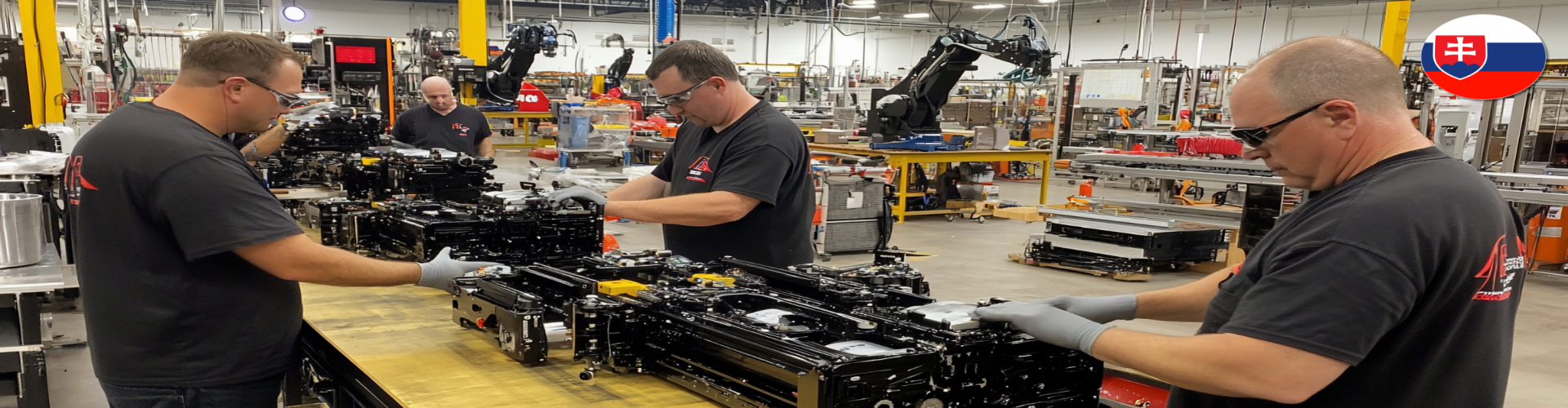
An automotive assembly line depends on every station completing its work correctly and on time. If one station is understaffed or workers are not ready for the task, the effect can move along the entire line.
For employers planning to hire assembly line workers for Slovakia, recruitment is therefore not only about reaching a headcount. Workers need to fit the pace, work method and quality requirements of the production environment.
Slovakia has one of Europe's strongest automotive manufacturing bases. The sector includes vehicle manufacturers and a large supplier network, while current labour-market information continues to show demand for assembly workers and production operators in automotive and engineering regions.
Dynamic Staffing Services supports automotive and manufacturing employers with international recruitment. We help companies define assembly roles, source suitable candidates, coordinate screening and employer selection, support recruitment documentation and manage deployment coordination.
A Missing Worker Can Become a Line Problem
Assembly-line staffing works differently from general factory recruitment.
Workers are placed at specific stations. Each station has a task, expected work sequence and required output. If staffing is weak at one point, supervisors may need to move employees from another area or ask the existing team to cover additional work.
This can affect line balance.
Employers should therefore identify which stations are most sensitive to workforce gaps before recruitment begins.
Questions to consider include:
- Which stations require previous assembly experience?
- Which tasks can be learned through employer training?
- Where are current vacancies affecting line performance?
- Which positions have the highest employee turnover?
- Are some stations harder to fill than others?
- Will additional workers be needed for a new model or production increase?
- How many employees need to be ready before the next production phase?
Dynamic Staffing Services uses these details to understand where the workforce is actually needed.
Recruit by Assembly Station, Not One General Job Title
"Assembly line worker" can cover many tasks.
A worker fitting interior components performs different work from someone installing mechanical parts. Another employee may handle fastening, component preparation, visual checking or sub-assembly.
Employers get better recruitment results when these duties are separated before sourcing starts.
A job requirement should explain:
- Main assembly task
- Components handled
- Tools used
- Level of manual work
- Whether drawings or work instructions are involved
- Quality checks performed by the worker
- Previous automotive experience required
- Shift arrangement
- Training provided after joining
Dynamic Staffing Services can then create candidate groups around the actual work.
This prevents candidates with very different backgrounds from being treated as equally suitable simply because they all have manufacturing experience.
For automotive employers, this is especially important where several production areas are recruiting at the same time.
Look for Consistency, Not Only Speed
Assembly work is often repetitive, but repetitive does not mean simple.
Workers need to follow the same work method throughout the shift while maintaining the required quality level.
A person who works quickly but regularly misses a step can create more problems than a worker who follows the correct process consistently.
Candidate screening should therefore consider the behaviours that matter on an assembly line.
These can include:
- Ability to follow instructions
- Attention to repeated tasks
- Hand coordination
- Basic tool handling
- Quality awareness
- Ability to work within a team
- Previous shift-work experience
- Reliability in a structured work environment
The exact criteria should come from the employer.
Dynamic Staffing Services does not assume that every automotive assembly role requires the same previous experience. Some positions may require experienced workers, while others may be suitable for candidates who complete the employer's training programme.
Clear requirements help us keep screening practical.
How Dynamic Staffing Services Recruits Assembly Line Workers
Automotive recruitment at scale needs a process that allows employers to review large candidate groups without losing control over role requirements.
Workforce Requirement Mapping
Dynamic Staffing Services begins by understanding the workforce numbers, assembly areas, shifts, experience requirements and planned joining dates.
If an employer needs workers for several areas, the requirement is separated by role.
For example, workers needed for component assembly can be screened differently from those required for machine-assisted production or quality-related tasks.
Candidate Sourcing and Screening
Candidates are then sourced against the agreed profile.
Dynamic Staffing Services has experience recruiting for manufacturing industries, including automotive, industrial production, packaging and other factory environments.
Where previous assembly experience is required, screening looks at the candidate's actual duties rather than the employer name or job title alone.
Where the employer is open to workers from other production backgrounds, Dynamic Staffing Services uses the agreed transferable skills as part of the shortlist.
Employer Assessment
The assessment should reflect the level of the job.
Assembly roles do not always require complex technical testing. Depending on the employer's process, candidates may complete an interview, basic work-related assessment or a simple practical activity.
An assessment could check whether a candidate can follow a work sequence, identify components, use basic tools or complete a repetitive task correctly.
The employer defines the final standard.
Dynamic Staffing Services coordinates candidate participation and selection arrangements, while the employer retains the final hiring decision.
Selection and Documentation
After selection, candidates move into the documentation stage.
Dynamic Staffing Services coordinates recruitment-related candidate documents and communication so selected workers continue progressing through the required process.
For larger hiring programmes, keeping candidates organised by role and joining group gives the employer a clearer picture of recruitment progress.
Prepare Workers for the Assembly Environment
Selection is only one part of workforce readiness.
An employee joining an automotive assembly line still needs to understand the employer's workplace, safety rules, station instructions, quality expectations and line procedures.
Employers should plan this onboarding period before the workers arrive. A new group should not automatically be treated as full production capacity from the first shift.
The time needed for workers to reach the expected level depends on the job and the employer's training process.
This is particularly important during production ramp-ups. If an employer needs 80 productive workers on a certain date, recruitment planning should consider when workers need to arrive and complete orientation or job training before that date.
Dynamic Staffing Services works with the employer's expected joining schedule so recruitment can be planned backwards from the point when the workforce is actually required.
Assembly Recruitment Should Protect Quality as Output Increases
Automotive manufacturers operate under clear quality requirements.
When output increases, workforce planning must protect those standards.
Recruiting additional employees without clearly defining their stations and training needs can place more pressure on supervisors and experienced workers.
A better approach is to connect workforce growth with line readiness.
Employers should know:
- Where new workers will be placed
- Who will train them
- Which stations require experienced employees
- How workers will be assessed after training
- Whether production will increase in stages
- How many new employees can be absorbed at one time
This helps HR and production teams work from the same plan.
Dynamic Staffing Services supports this process on the recruitment side by organising workers according to the employer's role categories and expected joining requirements.
The business benefit is not simply a larger workforce. It is better control over how new employees enter the production operation.
Employment Compliance Must Be Included in the Hiring Schedule
Employers recruiting third-country nationals for Slovakia also need to allow time for the applicable employment and residence process.
Current Slovak rules provide different routes depending on the worker's situation. A third-country national may require temporary residence for employment linked to a vacancy, a work permit in specified circumstances, or another legally permitted status.
The correct process depends on the individual employment arrangement.
Dynamic Staffing Services supports recruitment-related documentation and candidate coordination after selection.
Employers should include these stages when setting workforce dates rather than treating immigration and residence procedures as an activity that begins after the production plan has already been fixed.
Final work, residence and other statutory approvals remain subject to applicable Slovak requirements. Dynamic Staffing Services does not guarantee approvals or fixed processing times.
Why Automotive Employers Work with Dynamic Staffing Services
Dynamic Staffing Services has more than 49 years of international recruitment experience.
Manufacturing is an established part of our recruitment work, including automotive and other industrial production environments.
Dynamic Staffing Services supports employers with:
- Workforce requirement planning
- Candidate sourcing
- Manufacturing experience screening
- Employer assessment coordination
- Bulk recruitment organisation
- Candidate documentation
- Recruitment communication
- Deployment coordination
Our current international network includes 24 offices across 16 countries.
For assembly-line recruitment, our focus is on understanding where the worker fits into the employer's production process.
That means Dynamic Staffing Services does not view 100 assembly workers as one general group if they are actually needed across several stations or work areas.
For employers looking to hire assembly line workers for Slovakia, this provides a more organised way to connect recruitment numbers with automotive production requirements.
Contact Us
If your automotive plant or component manufacturing facility in Slovakia needs assembly line workers, Dynamic Staffing Services can support your international recruitment requirements.
Share your assembly roles, workforce numbers, shift requirements, experience criteria and expected joining schedule with our team.
Email: clientservices@dss-hr.com
